Saturday, July 3, 2010

Belcanto finale 2010 European Tour Concert takes place at St. Michael's Church in Budapest on July 4 at 3 pm

On Sunday, July 4, at 3 pm, the singers from Danville, CA, are presenting their last formal concert in the heart of Budapest, at the beautiful baroque church of St. Michael.
Here is a short history of the finale concert venue for the ensemble under the direction of Mr. Bruce Koliha:
The Church of St Michael was built in the 18th century on the spot of a medieval dominican church destroyed during turkish wars. A temporary chapel was standing here between 1700 and 1716, present church was finished only by 1765. Figure of Virgin Mary adorning its frontal facade is considered to be created by Donner. Statues of Saint Dominic and Saint Thomas Aquinas carved by Joseph Hebenstreit also decorate this facade. The church had a vivid history in the XIXth century: although destroyed by fire and floods, it managed to survive and got restored. The latest restoration started in 1999. The single-naved church was decorated with ceiling frescoes and side paintings in the middle of the 18th century. The main altar, inlaid benches, furniture of the sacristy date back to 1760, they are works of Dominican monks. The main altar shows St. Dominic with Virgin Mary handing a rosary to him. Statues of important religious persons in connection with the Dominican order can be found around the painting. On the left: statue of Pope Pius V. and St. Antoninus, Archbishop of Florence. On the right: St. Augustine and Pope Innocent V. The first organ of the church was built in 1801 by organ builder Joseph Herodek which was entirely rebuilt by company Rieger in 1893. It was again renovated in 1951. Baroque statues depicting King David playing the harp and two angels are shown on the top of the organ.

Welcome to Budapest!

Budapest is the last stop on the Incantato Tours itinerary for Belcanto in 2010. Here are some interesting facts about the vibrating city:

Budapest is the capital of Hungary. As the largest city of Hungary, it serves as the country's principal political, cultural, commercial, industrial, and transportation center and is considered an important hub in Central Europe. In 2009, Budapest had 1,712,210 inhabitants, down from a mid-1980s peak of 2.1 million. The Budapest Commuter Area (or Greater Budapest) is home to 3,271,110 people. The city covers an area of 525 square kilometres (202.7 sq mi) within the city limits.
Budapest became a single city occupying both banks of the river Danube with a unification on 17 November 1873 of right (west)-bank Buda and Óbuda with left (east)-bank Pest.
Aquincum, originally a Celtic settlement, was the direct ancestor of Budapest, becoming the Roman capital of Lower Pannonia. Magyars arrived in the territory in the 9th century. Their first settlement was pillaged by the Mongols in 1241-42. The re-established town became one of the centers of Renaissance humanist culture in the 15th century. Following the Battle of Mohács and nearly 150 years of Ottoman rule, development of the region entered a new age of prosperity in the 18th and 19th centuries, and Budapest became a global city after the 1873 unification. It also became the second capital of Austria-Hungary, a great power that dissolved in 1918. Budapest was the focal point of the Hungarian Revolution of 1848, the Hungarian Soviet Republic of 1919, Operation Panzerfaust in 1944, the Battle of Budapest of 1945, and the Revolution of 1956.
Regarded as one of the most beautiful cities in Europe, its extensive World Heritage Site includes the banks of the Danube, the Buda Castle Quarter, Andrássy Avenue, Heroes' Square and the Millennium Underground Railway, the second oldest in the world. Other highlights include a total of 80 geothermal springs, the world's largest thermal water cave system, second largest synagogue, and third largest Parliament building. The collections of the Natural History Museum and the Museum of Fine Arts are also significant. The city attracts over 20 million visitors a year.

Friday, July 2, 2010

Belcanto sings at the Benedictine Abbey of Goettweig on Saturday, July 3, at 4 pm

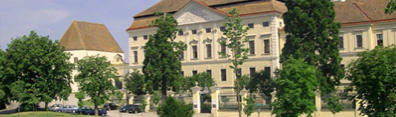
The abbey is situated on the Göttweig Mountain and - because of its location - sometimes called the Austrian Montecassino. The Monastery founded in 1083 by Saint Altmann sits on a hill 449 m above sea level in the Dunkelsteiner Forest south of the city of Krems, on the eastern edge of the world-famous Danube Valley called the Wachau. With the Wachau, Göttweig was in 2001 placed on the UNESCO World Heritage List. And on Saturday, July 3, at 4 pm, Belcanto will be performing in the prestigious Stiftskirche pictured below.

Goettweig Abbey by Herr Specht.

At first, Augustines worked here, to be followed in 1094 by Benedictine monks from the Monastery of St. Blasien in the Black Forest. The Benedictines have been living, learning and teaching on Göttweig Mountain for more than 900 years. The goal of their life is to glorify God in prayer and work according to the Rule of their Order’s founder, Saint Benedict, the Patron Saint of Europe. Currently 54 monks belong to the monastic community. More than 30 of them give pastoral care to parishioners and pilgrims in the Dioceses of Vienna and St. Pölten. Forestry and viticulture have been the economic basis of the Monastery since it was founded - today completed by various touristic and economic efforts. For more information, visit the official website Benediktiner Stift Goettweig.

Daytrip to Vienna

Belcanto visits Vienna on Friday, July 2, during the Performance Tour 2010. Incantato Tours discovered some interesting facts about the Austrian city:

Vienna is the capital of the Republic of Austria and one of the nine states of Austria. Vienna is Austria's primary city, with a population of about 1.7 million (2.3 million within the metropolitan area, more than 25% of Austria's population), and is by far the largest city in Austria, as well as its cultural, economic, and political centre. It is the 10th largest city by population in the European Union. Vienna is host to many major international organizations such as the United Nations and OPEC. Vienna lies in the east of Austria and is close to the Czech Republic, Slovakia and Hungary. Founded around 500 BC, Vienna was originally a Celtic settlement. In 2001, the city centre was designated a UNESCO World Heritage Site and in 2005 an Economist Intelligence Unit study of 127 world cities ranked it first equal with Vancouver for the quality of life. This assessment was mirrored by the Mercer Survey in 2009.
Art and culture have a long tradition in Vienna, including theater, opera, classical music and fine arts. The Burgtheater is considered one of the best theaters in the German-speaking world alongside its branch, the Akademietheater. The Volkstheater Wien and the Theater in der Josefstadt also enjoy good reputations. There is also a multitude of smaller theaters, in many cases devoted to less mainstream forms of performing arts, such as modern, experimental plays or cabaret.
Vienna is also home to a number of opera houses, including the Theater an der Wien, the Staatsoper and the Volksoper, the latter being devoted to the typical Viennese operetta. Classical concerts are performed at well known venues such as the Wiener Musikverein, home of the Vienna Philharmonic Orchestra, and the Wiener Konzerthaus. Many concert venues offer concerts aimed at tourists, featuring popular highlights of Viennese music (particularly the works of Wolfgang Amadeus Mozart and Johann Strauss).
In recent years, the Theater an der Wien has become widely known for hosting premieres of musicals, although it has recently devoted itself to the opera again. The most successful musical by far was "Elisabeth", which was later translated into several other languages and performed all over the world. The Haus der Musik ("house of music") opened in 2000.

Thursday, July 1, 2010

Home away from Home on July 1, 2 & 3: Jugendhaus Stift Göttweig

On July 1, 2 and 3 the travelers of Belcanto are going to stay at the Jugendhaus Stift Göttweig. The former boy school dormitory is located right next to the Göttweig abbey which was founded as a monastery of canons regular by Blessed Altmann, Bishop of Passau. The high altar of the church was dedicated in 1072, but the monastery itself not until 1083: the foundation charter, dated 9 September 1083, is still preserved in the abbey archives.

Thursday, July 1: Belcanto explores Český Krumlov

On the way from Prague (Czech Republic) to Göttweig (Austria), the travelers visit beautiful Český Krumlov, today, July 1. Český Krumlov is a small city in the South Bohemian Region of the Czech Republic, best known for the fine architecture and art of the historic old town and Český Krumlov Castle. Old Český Krumlov is a UNESCO World Heritage Site and was given this status along with the historic Prague castle district. To learn more about the city, please click here.

Tuesday, June 29, 2010

Incantato Performance Venue for June 30 at 6 pm: Belcanto sings at Chapel of St. Ann in Panenské Břežany

The beautiful Chapel of St. Ann was built by architect Jan Blažej Santini Aichel in the 18th century. It is the Incantato performance venue for Belcanto on June 30 at 6 pm. The chapel is based on circles crossing each other in intricate ways. The organ is precious and can be used for concerts.
Jan Blažej Santini Aichel (February 3, 1677 - December 7, 1723) was a Czech architect of Italian descent, whose major works represent a curious amalgam of the Gothic and Baroque styles. Santini was born in Prague to a family of stonemasons. His grandfather Antonin Aichel moved from Italy to Prague in the 30th of the 17th century. Borromini's influence is apparent in his predilection for star-shaped forms and complex symbolism. Many of his buildings are airy and elegant, yet he was considered a maverick genius by his contemporaries and exerted little influence on subsequent generations of Bohemian architects.

Home away from Home on June 29 & 30: Hotel Luník in Prague

The traditional 3 star family-style hotel Luník is situated in a peaceful part of the historical centre of Prague (see map). It offers 35 double rooms which are equipped with en suite bathrooms (shower, WC, hair-dryer), TV (satellite programms in English and German), radio, telephone with direct dialing and a room safe. Hotel Luník offers buffet-style breakfasts. The reception desk and the exchange office are at your disposal 24 hours a day.


Belcanto arrives in Prague on Tuesday, June 29


Prague is the capital and largest city of the Czech Republic. Situated on the Vltava River in central Bohemia, Prague has been the political, cultural and economic centre of the Czech state for more than 1100 years. For many decades during the Gothic and Renaissance eras, Prague was the permanent seat of two Holy Roman Emperors and thus was also the capital of the Holy Roman Empire. Today, the city proper is home to about 1.3 million people, while its metropolitan area is estimated to have a population of over 1.9 million. Since 1992, the extensive historic centre of Prague has been included in the UNESCO list of World Heritage Sites, making the city one of the most popular tourist destinations in Europe, receiving more than 4.1 million international visitors annually.
Prague is traditionally one of the cultural centres of Europe, hosting many cultural events. There are hundreds of concert halls, galleries, cinemas and music clubs in the city. Prague hosts Music Festivals including the Prague Spring International Music Festival, the Prague Autumn International Music Festival and the Prague International Organ Festival. Film festivals include the Febiofest, the One World and Echoes of the Karlovy Vary International Film Festival. Prague also hosts the Prague Writers' Festival, the Summer Shakespeare Festival, the Prague Fringe Festival, the World Roma Festival as well as hundreds of Vernissages and fashion shows.

Monday, June 28, 2010

Belcanto performs at Church of St. Havel in Chlumec u Ústí nad Labem on Monday, June 28, at 5 pm - Exchange concert!

Incantato Tours proudly presents the Belcanto concert venue for Monday, June 28 at 5 pm: Kostel s. Havla (Church of St. Havel) in Chlumec u Ústí nad Labem. And it's not only the church that makes the performance on that day special: You are going to meet and sing together with the local choir, "Chlumecky pevecky sbor". Concert Manager for Central Europe, Karolina, connected with the local choir and their director for a special exchange and concert in 2007, and a friendship started between the group and several of us at Incantato. In 2009, the Chlumec Choir visited the US and the choir they had hosted - now for 2010, they invited the Monte Vista High School Choir to visit them and their families. To learn more about the choir, please click here.
Today's Church of St. Havel was built on the site of an older Gothic church, around the year 1359. In 1590 it was rebuilt in Baroque style. 1813 the church was damaged and some years later rebuilt again. In the tower there is a beautiful bell (1687) designed by Nicholas Loew. Inside you can also find historic Renaissance tombs of the noble family Kölbl von Geising. The organ dates from the year 1852.

Belcanto explores Chlumec u Ústí nad Labem on Monday, June 28 - Overnight stay in host homes

Chlumec is a village and municipality in Ústí nad Labem District in the Ústí nad Labem Region of the Czech Republic. The municipality covers an area of 12.87 square kilometres (4.97 sq mi), and has a population of 4,402. Chlumec lies approximately 9 kilometres (6 mi) north-west of Ústí nad Labem and 76 km (47 mi) north-west of Prague. Ústí nad Labem is the 9th-most populous city in the country. Ústí is situated in a mountainous district at the confluence of the Bílina and the Elbe (Labe) Rivers, and, besides being an active river port, is an important railway junction. It is the birthplace of the painter Anton Raphael Mengs.
Ústí nad Labem was mentioned as a trading centre as early as 993. The city was founded by King Otakar II of Bohemia in the latter part of the 13th century. In 1423 it was pledged by Emperor Sigismund to Elector Frederick I of Meißen, who occupied it with a Saxon garrison. In 1426 it was besieged by the Hussites, who on June 16, 1426, though only 25,000 strong, defeated with great slaughter a German army of 70,000 which had been sent to its relief; the town was stormed and sacked the next day. After lying waste for three years, it was rebuilt in 1429. It suffered much during the Thirty Years' War and Seven Years' War. Not far from Ústí is the village of Chlumec, where, on August 29-August 30, 1813, a battle took place between the French Empire under Vandamme and an allied army of Austrians, Prussians, and Russians. The French were defeated and Vandamme surrendered with his army of 10,000 men. During the 19th century the city became heavily industrialized and due to the large-scale immigration the number of inhabitants grew from 2,000 to over 40,000 making Ústí one of the biggest cities in Bohemia. Mining, chemical industry and river transport were its most important assets. The local river port became the busiest one in the whole Austro-Hungarian Empire surpassing the seaport in Trieste. Nowadays it is the industrial city with chemical establishments, metallurgy manufacture, machinetool industries, textiles and nutriment industry. Ústí was a center of early German National Socialism. On November 15, 1903, the Deutsche Arbeiterpartei in Österreich ("German Workers' Party in Austria") was formed; it would become the basis for the Sudeten German National Socialist Party and Austrian National Socialism. Much of their literature and books were printed in Ústí. From April 17 to April 19, 1945 the city was bombed by the Allied Forces and over 500 people lost their lives. On July 31, 1945, the Ústí Massacre against German civilians occurred. In 1945 and 1946, over 53,000 ethnic Germans were expelled from the area. Emigrants from the Soviet Union, Slovakia, and Romania settled in the city, among them many Roma and Sinti. During the 1970s-1980s large numbers of paneláks were constructed in Ústí. After the fall of communism in Czechoslovakia in the Velvet Revolution of 1989, the city's heavy industry suffered economic troubles. The Střekov castle is located in a southern suburb of the city. Ústí is a center for tourism owing to the romantic landscape of the Bohemian Highlands (České středohoří) and the České Švýcarsko national park.
The picture shows Ústí nad Labem.

Sunday, June 27, 2010

Belcanto sings at the Kaiser-Wilhelm-Gedächtniskirche in Berlin on Sunday, June 27, at 6 pm

On Sunday, June 27, at 6 pm the Belcanto singers will perform at the Kaiser-Wilhelm-Gedächtniskirche in Berlin during the choir vesper.

The Protestant Kaiser Wilhelm Memorial Church (in German: Kaiser-Wilhelm-Gedächtniskirche) is located on the Kurfürstendamm in the center of the Breitscheidplatz. The original church on the site was built in the 1890s. It was badly damaged in a bombing raid in 1943. The present building, which consists of a church with an attached foyer and a separate belfry with an attached chapel, was built between 1959 and 1963. The damaged spire of the old church has been retained and its ground floor has been made into a memorial hall.
The foundation stone for the old church was laid on March 22, 1891. The competition for the design was won by Franz Schwechten who planned for a large church to be built in neo-romanesque style, including 2,740 square meters of wall mosaic. The spire was 113 meters (370' and 8.81") in stature and the nave seated over 2,000 people. The church was consecrated on September 1, 1895. By this time of the consecration the entrance hall in the lower section had not been completed. This was opened and consecrated on February 22, 1906. In the Second World War, on the night of November 23, 1943, the church was irreparably damaged in an air raid. The church was largely destroyed but part of the spire and much of the entrance hall survived. The entrance hall in the base of the damaged spire was reopened to visitors, having been consecrated on 7 January 1987.
Its floor contains a mosaic of the Archangel Michael fighting the dragon. The vault shows a procession of Hohenzollern princes, early and more recent. Other mosaics show important monarchs in medieval Germany, Reformation thinkers and Reformation princes. Bas-relief sculptures illustrate scenes from biblical stories, scenes from the life of Kaiser Wilhelm I and symbolic figures representing war and peace. In the north apse are 16 display panels which tell the story of the old church and its destruction. At the opposite end of the hall are three items which symbolize the history of the church. In the middle is a damaged statue of Christ which originally stood on the altar of the old church. To its right is the Cross of Nails which was made from nails in the roof timbers of Coventry Cathedral. This cathedral had been severely damaged in a German air raid on 14 November 1940. To the left of the statue of Christ is an icon cross which was given by the Russian Orthodox Church and handed over in 1988. Outside the hall are four sandstone figures made by Stefan Kaehne.

The pictures are from the official website of the church.

Saturday, June 26, 2010

Home away from Home on June 26, 27 & 28: Hotel Holiday Inn Berlin-Mitte

The Holiday Inn Berlin-Mitte welcomes its guests in the new "green" center of Berlin, right at the park Humboldthain. From here, you will have a perfect start to the "Neue Mitte" of Berlin with the Reichstag, Museum Island, the Berlin Cathedral, the Potsdamer Platz, the boulevard Unter den Linden and the famous shopping street Friedrichstrasse. The rooms come with: minibar, direct dialing telephone, satellite-TV, premiere pay TV, fax-modem-access, desk and chair, Wireless Lan.

Welcome to Berlin!


  • Berlin is one of the most visited tourist destinations in the European Union.
  • The name Berlin is of unknown origin, but may be related to the Old Polabian, an West Slavic language. The word "berl" means "swamp".
  • The famous Brandenburg Gate is an iconic landmark of Berlin and Germany. It also appears on German euro coins.
  • In 1963 at the "Rathaus Schöneberg" (city hall of Schöneberg), former president of the US, John F. Kennedy, made his famous "Ich bin ein Berliner!" speech ("I am a citizen of Berlin").
  • Berlin maintains official partnerships with 17 cities. Town twinning between Berlin and other cities began with Los Angeles in 1967.
  • Young Germans and international artists continue to settle in the city, and Berlin has established itself as a center of youth and popular culture in Europe. Signs of this expanding role was the 2003 announcement that the annual "Popkomm", Europe's largest music industry convention, would move to Berlin after 15 years in Cologne.
  • There are seven symphony orchestras in Berlin - The Berlin Philharmonic Orchestra is one of the preeminent orchestras in the world.
  • Berlin is an important center in the European and German film industry. It is home to more than one thousand film and television production companies, 270 movie theaters, and around 300 national and international co-productions are filmed in the region every year.
  • Berlin's Botanical Garden includes the Botanic Museum Berlin. With an area of 43 hectares (110 acres) and around 22,000 different plant species it is one of the largest and most diverse gardens in the world.
  • Typical Berliner dishes include a "Currywurst" (spiced sausage) which was invented in Berlin in 1949.
  • Berlin has established a high profile reputation as a host city of international sporting events. Berlin hosted the 1936 Olympics and was the host city for the 2006 FIFA World Cup Final (Soccer).

Thursday, June 24, 2010

Belcanto performs at the Church of St. Anthony in Poznań on Friday, June 25, at 7:15 pm


Incantato proudly presents the Belcanto performance venue for Friday, June 25, 7:15 pm: the Church of St. Anthony in Poznań. Here is some information about this special venue:
The conventuals (black friars) settled in Poznań in the 17th century. The church was commissioned from Jan Koński and built atop Castle Hill (presently Przemysł Hill) in the years 1674-1757. The monastery was erected in the years 1672-1749 east of the church but it was partly dismantled after the suppression of the order in 1834; only the north part survived to the present day. In the 19th century the church was given to German Catholics by the Prussian authorities. The black friars returned in 1921. Heavily damaged in the war, the church was renovated in 1945.
It is a basilica with the nave flanked by two aisles that stop at two chapels; there is also a chapel in the west aisle and a gallery over three bays in both aisles. The presbytery and the nave are covered with a barrel vault with lunettes, the aisles are groin vaulted whereas the chapel adjoining the west aisle is sail vaulted. Both chapels at the end of the aisles have domes with lanterns. The church is lavishly decorated with stucco-work and the polychrome decoration from around 1702 is the work of the Franciscan monk Adam Swach.
The nave is adjoined by two square chapels covered with domes and topped by lanterns. The Chapel of Mother of God was built in 1681 and it features the miraculous painting of Mother of God, Our Lady of Poznań. It is a copy of the miraculous painting from the Sanctuary of Our Mother of Consolation from Borek - Zdzież.

Wednesday, June 23, 2010

Belcanto arrived safely

The Belcanto singers arrived safely in Warsaw, their tour manager Karolína just reported over the phone. They are on their way to the hotel Novotel Warszawa Centrum and are looking forward to meet the land-only travelers. At 8 pm local time they will enjoy their welcome buffet dinner together. The Incantato Tours Team wishes Belcanto a wonderful first night in Europe!